TL;DR Decision
Semrush is a strong fit when your team runs SEO weekly and needs one broad operational workspace.
- Primary recommendation: choose Semrush for recurring execution across research, planning, and audits.
- Secondary recommendation: choose Ahrefs if your workflow is mainly backlink-first research depth.
- Not recommended now: teams without weekly ownership and content cadence.
Sources reviewed in April 2026.
Pricing checked on: 2026-04-16.
How We Evaluate This Review
We score Semrush on five buyer-relevant dimensions:
- Workflow usability for non-experts
- Actionability of outputs (does insight become page actions?)
- Operational breadth for weekly SEO routines
- Cost-fit relative to execution consistency
- Risk level during trial period
Fit Snapshot (Who Should Use It)
| Team situation | Fit level | Why |
|---|---|---|
| Weekly publishing team with SEO owner | Strong | Unified workflow improves execution speed and consistency |
| Agency with multi-project operations | Strong | Broad toolkit reduces tool-switching overhead |
| Solo user with occasional checks only | Medium to weak | Cost and complexity may exceed practical value |
| Link-centric specialist workflow | Medium | Often workable, but specialist stacks may feel more efficient |
What Semrush Does Well (Practical, Not Hype)
1) Unified operational flow
It reduces context switching between keyword planning, content work, and technical checks.
2) Beginner-accessible task generation
For non-specialists, the platform can turn data into clear next tasks more quickly than fragmented stacks.
3) Execution support for recurring teams
Semrush becomes more valuable when your team runs a fixed weekly SEO cycle.
Tradeoffs You Should Know
1) Subscription pressure without discipline
If execution is irregular, cost feels heavy quickly.
2) Breadth can overwhelm early users
Without a fixed routine, teams may spend time exploring dashboards instead of shipping pages.
3) Not always the best specialist fit
If your workflow is almost entirely link intelligence, alternatives may align better.
14-Day Trial Script (Realistic)
- Set one project and baseline core pages.
- Build one topic cluster and page plan.
- Run one technical audit cycle and fix high-impact issues only.
- Measure output quality and decision speed at day 14.
Keep if:
- output became clearer and faster,
- publish quality improved,
- team can sustain weekly use.
Cancel or switch if:
- module complexity slows shipping,
- insights do not become actions,
- cost cannot be justified by outcomes.
Real-World Case (How a Small Team Actually Uses It)
This is a reproducible operator case format, not a claim of guaranteed results.
For a real-world example of keyword research in action, see my 3AM SEO Detective Case Study — how I used Semrush to find a million-dollar keyword with a practical workflow you can replicate.
Case setup
- Team: 1 founder + 1 part-time content operator
- Site stage: early-to-mid SEO, limited process maturity
- Goal: test whether Semrush improves weekly execution, not just reporting
- Duration: 14 days
Operating routine
- Build one topic cluster with commercial intent.
- Turn that cluster into one weekly page queue.
- Run one technical issue pass and fix only high-priority blockers.
- End each session with one concrete publish/no-publish decision.
Session log template
| Session | Planned tasks | Completed tasks | Time spent | Output quality (1-5) | Decision clarity (1-5) |
|---|---|---|---|---|---|
| Week 1 / Session A | |||||
| Week 1 / Session B | |||||
| Week 2 / Session A | |||||
| Week 2 / Session B |
Day-14 decision rule
- Keep Semrush if weekly outputs become more consistent and easier to prioritize.
- Switch if the team still spends most time navigating tools instead of publishing.
- Delay premium purchase if process discipline is still unstable.
Decision Routing
- Need direct head-to-head choice now?
- Need category-level direction first?
- Need budget-first fallback?
- Need fundamentals before purchase?
CTA Path
If you are near purchase decision
Verify official Semrush pricing and run the 14-day script above before annual commitment.
If you still need cross-vendor confidence
Run direct comparison next:
Next Step
Run one 14-day Semrush test on your real workflow. Decide with logs, not impressions.
FAQ
Is Semrush worth it for beginners?
Yes, if beginners use a narrow weekly workflow and avoid trying every module at once.
Is Semrush better than Ahrefs?
Not universally. Semrush often wins on operational breadth, Ahrefs often wins for link-centric workflows.
What is the biggest beginner mistake?
Buying first, process later. Build weekly routine first, then scale tool usage.
Pricing Evidence Snapshot (Manual)
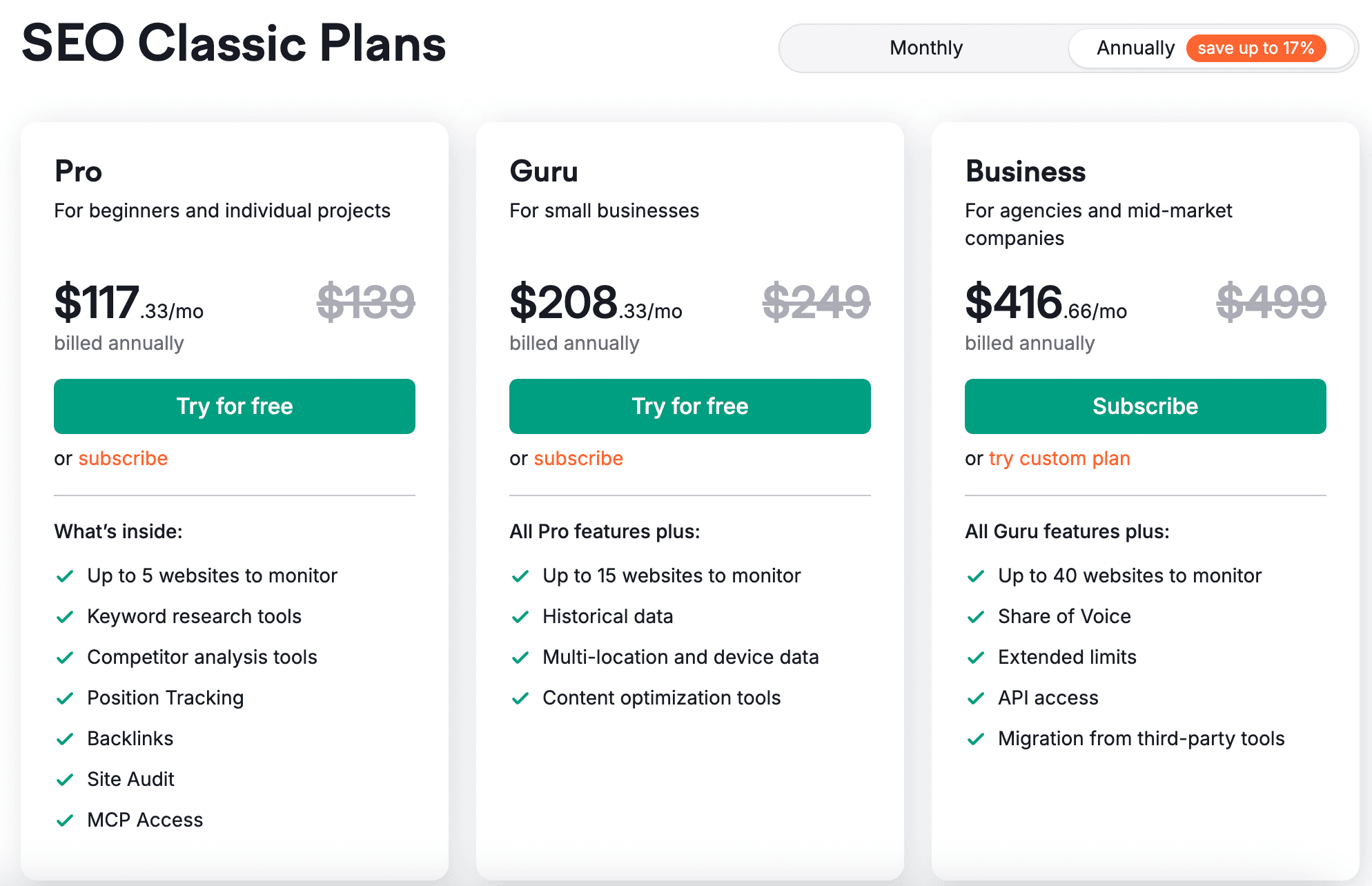
Manual snapshot date: April 16, 2026 (annual billing view shown).
- Pro: $117.33/mo billed annually (list price shown: $139)
- Guru: $208.33/mo billed annually (list price shown: $249)
- Business: $416.66/mo billed annually (list price shown: $499)
Evidence Matrix
| Claim ID | Claim | Source Type | Confidence | Limitation |
|---|---|---|---|---|
| C1 | Semrush Pro: $117.33/mo billed annually | Tier A (Official) | High | None |
| C2 | Semrush Guru: $208.33/mo billed annually | Tier A (Official) | High | None |
| C3 | Semrush Business: $416.66/mo billed annually | Tier A (Official) | High | None |
| C4 | Users report strong operational workflow for recurring SEO | Tier B (Independent) | Medium | Sample from G2 reviews only |
| C5 | Learning curve can overwhelm beginners | Tier B (Independent) | Medium | Subjective sentiment |
| C6 | Better for execution breadth than link-centric depth | Tier B (Independent) | Medium | Comparative claim |
Sources
Tier A (Official)
- Semrush official pricing: https://www.semrush.com/pricing/
- Semrush feature documentation: https://www.semrush.com/features/
Tier B (Independent)
- G2 reviews: https://www.g2.com/products/semrush/reviews
- Capterra reviews: https://www.capterra.com/p/145766/Semrush/
- Trustpilot: https://www.trustpilot.com/review/semrush.com
Tier C (Community)
- Reddit r/SEO discussions: https://www.reddit.com/r/SEO/search/?q=semrush
- Indie Hackers: https://www.indiehackers.com/search?query=semrush
Manual Evidence
- Pricing snapshot: /evidence/semrush-pricing-2026-04-16.png
What We Still Cannot Verify
- Real-time user sentiment beyond reviewed sources
- Specific plan limits beyond published pricing (e.g., exact project counts for edge cases)
- Long-term ROI claims (require user-specific context)
Disclosure
This page may contain affiliate links. That does not change our fit and tradeoff criteria.